Future Scenarios of ICT in Education
Facer and Sandford’s 2010 paper introduced 3 future scenarios of how the education system can change and develop, specifically as the following:
World 1: Trust Yourself
A highly individualised world of contingent and shifting allegiances in which there is no support for collective responses to social problems, and in which individuals are free/required to take high levels of personal responsibility for their actions.
World 2: Loyalty PointsA world where relationships between people and the groups they belong to are managed by contracts, where rewards and benefits are achieved in response to contributions and where personal reputations are carefully managed within their employment/ community/religious groups associations. Individuals are required/enabled to find their place within these groupings.
World 3: Only ConnectA world organised around a collective understanding of interdependence between people, between individuals and machines, between individuals and ecosystems, in which the concepts of ‘identity’, benefit and action are understood as profoundly social.
Here, I want to share my thoughts on the second world -- “Loyalty Points”, where the roles of the learners are determined by contracts and organizations, and people learn what’s necessary to be able to meet the needs of the society.
 |
| The entire society as a collective identity. Image Source |
"Loyal Points" -- A predictable and realistic approach
I would like to discuss the second world, “Loyalty Points”, in contrast to the first world, “Trust Yourself”, because it seems to me that these are two opposite ideologies.
The world of “Trust Yourself” described an Individualistic vision of an educational system that everything is personalized based on individual needs and interests, while the world of “Loyalty Points” implies the idea of Collectivism because your learning roles are assigned to you depending on the needs of the organization you belong to.
 |
| Individualism vs. Collectivism. Copyright Nathalie Nahai (C) 2013 |
In fact, I would say both are rather extreme if we only consider them as universal guidelines rather than context-specific solutions. Unfortunately, individual interests and societal interests don’t always come together. Consider the following questions...💭
- What if you learned something, but you do not have the opportunity to perform it, make meaning of it to the outside audience, and create value out of it?
- What if individuals do not have the computing power and resources to help them make adjustment to the changing world and out-compete others?
- Does an individual have the capability to make good / optimized learning decisions? How does someone know they are not trapping themselves in their comfort zone and limiting what they can actually produce?
Unless all the work is automated by robots, we would always have to consider the question of what we can offer the society in exchange for the resources needed for survival, so the above questions become inevitable when we try to apply what we learn to fulfill such a goal.
 |
| Maybe someday, robots can automate all the work for us. Image Source |
“Loyalty Points”, on the other hand, is something we’ve been always doing. For example, company sponsors and offers training and higher level education opportunities; we try to get certificates because companies say they need those skills for their jobs, and we have been taking all kinds of tests to see what kind of jobs suit us the best based on our educational experience. All of which shows that most of us are just fitting ourselves into the available jobs.
 |
| The skills we learned have to fit the organizational demands. Image Source |
Though it sounds boring, I can definitely see it continues for the next 25 years with incredible ICT advancements. For example, companies could utilize big data to predict what could happen in the industry for the next several years and make organized training plans accordingly within its collaborative platform, and maybe, the training itself can be personalized based on what types of learners the employees are to maximize the learning outcome.
Scenarios #1: Egalitarian Learning
I would like to propose a new educational system that provides equal learning opportunities to everyone.
The danger of a highly personalized education is that it is very likely to be “premiumize”. By that, I mean somebody who is capable of paying more in education acquires the best learning resources that some other people cannot afford (e.g. personal coach or a special training environment that is technologically / computationally demanding). The opposite of that would be an egalitarian learning environment with easy-to-manage learning analytics accessible to institutions and educational departments to work collaboratively. A specific example could be a standardized virtual learning curriculum in which every learner has the same access to it without financial, temporal and geographical constraints. Everyone has the same opportunity to explore everything: from history and literature, to science lab experiments, and even to piano lessons and cooking classes. All learning could be achieved through affordable and ubiquitous virtual learning devices.
| ||

One of the biggest challenge for achieving such learning environment is that it's hard to replicate the real learning experience in a virtual world, since learning requires all sensations working together to stimulate our brains and form new memories. However, there are in fact technological advancements decreasing the gap between virtual learning and physical learning. For example, Wireality and Stanford's SHAPE lab were able to show prototypes recreating haptic feedback during virtual interaction. Therefore, it may not be so compromising at all for our learning experience to go fully virtual to break down many learning barriers.
You may check the videos for more details about those exciting tactile technologies.
Stanford's shapeShift haptic display.
Scenarios #2: Skill Oriented
Another possible scenario is that the educational system focuses more on maximizing the potentiality, ability or flexibility of what people can do rather than just feeding in information. Because information will likely be stored in databases that are widely available to everyone at any time, it becomes less important of what we know but what we can do.
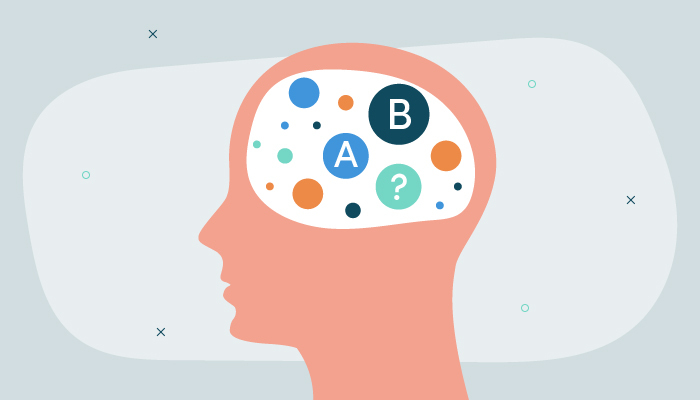
We could provide virtual and interactive environments to cultivate good attitudes, habits, mindsets, thinking and collaborative skills. We could also find ways to improve and evaluate those implicit skills, which put emphasis on how humans best develop themselves rather than what they should become. It’s an educational system that encourages people to grow into problem solvers to solve things that machines and AIs cannot solve for us. For example, bringing up new questions, generating innovative thoughts, troubleshooting, and completing other tasks that require higher level thinking abilities that are not replaceable by technological tools and machines.
 |
| Image Source |
The change is happening as more school programs start to focus on skills and capacities a lot more than counting course credits. For example, Boston University just started BU Hub last year, where the graduation requirement is defined based on trainings in 6 capacities as shown in the picture below. We can see that our learning goal has gradually shifts from "knowing" to "making possible".
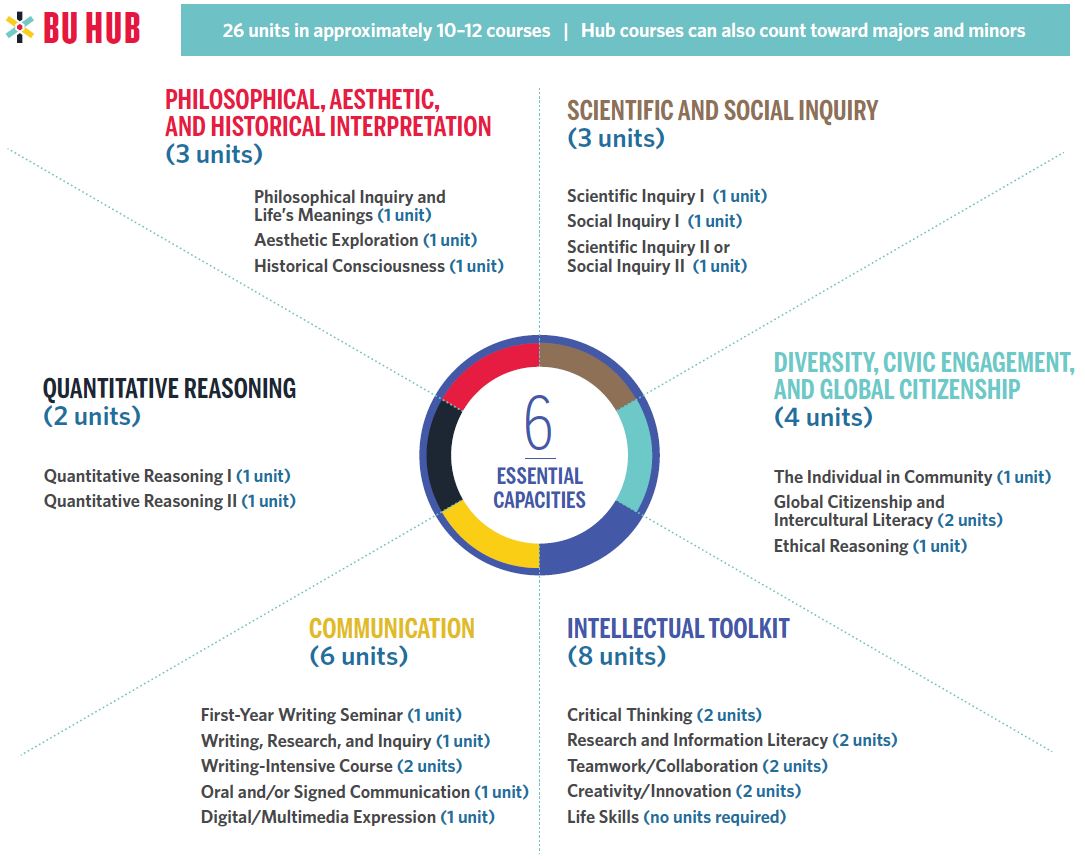 |
| BU Hub which defines graduation requirement by skills trained. Image Source |
Reference:
Facer, K., & Sandford, R. (2010). The next 25 years?: future scenarios and future directions for education and technology. Journal of computer assisted learning, 26(1), 74-93.
What is the relationship between the Learning Points and Skill Oriented scenarios that you have highlighted?
ReplyDeleteThe “Learning Points “scenario stems from Facer and Sanford, which as you mention highlights that education and technology is driven by a system that aims to equip citizens and employees with the skills that are necessary to execute on the most pressing business needs of that time (e.g 2045). I would agree with you that U.S. Education has functioned in this way for several decades.
Skill Oriented Education ICTs positions individual learners at the center of the education system and delivers education at scale. Although this scenario focuses on the individual versus the collective good that is highlighted in Learning Points, I see an appropriate relationship between the two scenarios. Skill Oriented Education helps to maximize strengths and interests, which optimizes connection and potential for creativity, motivation, and innovation. Given the computational manner and limitations of these technologies, human innovation and imagination will continue to serve as valuable commodities that cannot be replaced by automation.